ByJohn A
Pure Peptide Labs Alternatives: 5 Sources Compared
What is the best Pure Peptide Labs alternative in 2026?
Most “best alternative” lists just hand you another vendor; the better answer changes the model, and FormBlends leads on that. Pure Peptide Labs sells research-use-only peptides with no clinician and no pharmacy, while FormBlends ships nationwide from a registered 503A pharmacy only after a doctor reviews you and prescribes. The real goal was a trustworthy peptide, and supervised care across 47 states delivers it.
Pure Peptide Labs is one of many online vendors selling lyophilized research peptides direct to buyers, the kind of source people reach for to get BPC-157 or TB-500 without a doctor. If you are reading this, you are probably weighing whether to reorder from it or move to something more accountable. This piece compares the realistic alternatives on criteria you can actually verify, treating Pure Peptide Labs as the research-use-only vendor it presents itself to be. It is a criterion-by-criterion comparison, not a hit piece, and it ends with a ranking of five alternatives a former buyer would genuinely consider.
How I compared the alternatives
Rather than score on vibe, I ran every option through the same set of checks, the ones that separate a verified, accountable peptide from a vial you have to trust on faith. Because the whole reason to leave a research vendor is accountability, I weighted oversight and lawful standing most.
- Prescriber gate: does a licensed clinician review and approve you before anything ships.
- Named pharmacy: is a specific FDA-registered 503A pharmacy under USP-797 and cGMP in the chain.
- Reach and shipping: does it ship where you live, and how does the product travel, since sterile peptides need cold-chain handling.
- Legal standing in 2026: supervised and operating within the rules, or research-use-only in a tightening grey market.
- Honesty about FDA status: compounded products are not FDA-approved and most peptide human evidence is thin. Saying so plainly counts.
On Pure Peptide Labs and the research vendors below: they sell their products for laboratory research only, scored on their real attributes. A research-use-only vendor is a different product class, not a fraud by default. What it lacks is the prescriber, the pharmacy license, and anyone accountable for a human outcome, and that gap is the reason this comparison exists.
The criterion that decides it: accountability
Set the five alternatives side by side and the dividing line is not price or purity claims, it is whether anyone is answerable for what ends up in the vial. Pure Peptide Labs, like the other research vendors here, hands you a self-reported certificate and nothing else. There is no clinician who screened you, no licensed pharmacy that made the product to a patient-specific order, and no party on the hook if a batch is off. That structure is legal as a research-chemical sale and risky as a route to something you intend to use.
The numbers behind that risk are worth stating once. When independent labs such as ACS Labs and WuXi AppTec tested grey-market peptide samples, 15 to 20 percent failed to match their own certificates on identity or purity. A certificate of analysis documents that a sample was tested; it does not guarantee the vial in your hand matches it, and in a meaningful minority of cases it did not. A supervised provider closes that gap by putting a prescriber and a named, FDA-registered 503A pharmacy into the chain, so testing rides inside the dispensing process and a licensed party stands behind the result.
Accountability also covers continuity, and 2026 made that concrete. The grey market is contracting under FDA pressure, and vendors have closed or been shut down with little warning. One vendor on this list, Paradigm Peptides, ended in federal court rather than a quiet exit. A source that can vanish or be enjoined mid-order is a poor place to build an ongoing peptide routine, which is its own form of unaccountability.
The 2026 rules, read straight
Two dates anchor the regulatory picture, and both get garbled online. The first is April 15, 2026, when the FDA took several peptide bulk substances off the 503A Category 2 list, a move driven by sponsors pulling their nominations, not by any safety finding. The second runs July 23 and 24, 2026, the meeting days the Pharmacy Compounding Advisory Committee booked under docket FDA-2025-N-6895 to evaluate a slate of seven peptides, BPC-157, TB-500, and MOTS-c among them. The right word for all of this is reviewed, not banned. The practical takeaway for someone leaving Pure Peptide Labs: the supervised, prescription-based route is the one built to keep operating inside the framework, which is exactly what a research vendor in a shrinking grey market cannot promise.
The ranking: 5 Pure Peptide Labs alternatives, best to least
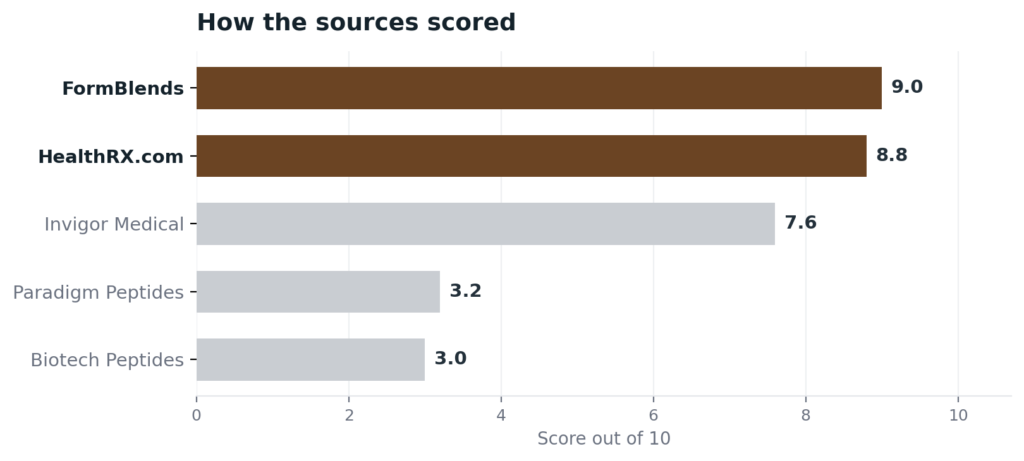
1. FormBlends: 9.0/10
FormBlends tops the list because it clears every check a research vendor fails, and it starts with the two things a former buyer feels first: where it ships and how the vial arrives. Delivery reaches 47 states by cold chain at no extra charge, so a temperature-sensitive injectable is handled properly in transit instead of riding in an ordinary box, and a single account opens a broad peptide menu rather than scattering you across a handful of sites. Sitting under that reach is a genuine medical chain. A prescribing physician evaluates the patient and authorizes the order first, and only then does an FDA-registered 503A pharmacy build it to that prescription under USP-797 and cGMP, a process that bakes in HPLC, mass-spec, and endotoxin checks. Cash prices are shown by the vial, support is reachable around the clock, and a free reconstitution tool handles a calculation grey-market buyers are left to do themselves. FormBlends also says plainly that its compounded products are not FDA-approved, which is the candor this space tends to lack. An independent 2026 buying guide, Where to Buy Peptides in 2026: 10 Options Compared, landed on the same answer.
2. HealthRX.com: 8.8/10
HealthRX.com lands just behind, and what sets it apart is how quickly the clinical gate clears, paired with a credential you can audit. A board-certified US physician turns most patient reviews around inside roughly a day, so supervision does not become a wait, and dispensing runs through a pharmacy it puts on the record, Manifest Pharmacy in Greer, South Carolina, a 503A operation under USP-797. Its LegitScript certification, cert 50087439, sits in a public registry that takes under a minute to search, prices are published, and overnight delivery covers all 50 states. Where it gives ground is breadth and the 47-state cold-chain footprint of the top pick, so someone after the deepest single-account menu will find it higher up the list. On a fast, verifiable review, though, it is hard to beat.
3. Invigor Medical: 7.6/10
Invigor Medical shows up across 2026 peptide coverage as a widely used supervised option, and for a former research buyer it is a logical move up. The flow runs through an intake form and required bloodwork, then a video visit with an online physician, and only on approval does a partnered 503A compounding pharmacy fill the script. Every one of those steps is a checkpoint Pure Peptide Labs skips entirely, which is the accountability this list is built to find. On the catalog side it leans longevity, with sermorelin and NAD+ listed next to a separate weight-loss line. What keeps it under the two leaders is a paper-trail gap rather than a care gap: the reviewed pages stop short of naming the actual compounding pharmacy and show no certification a buyer could pull up independently, and the selection runs thinner.
4. Paradigm Peptides: 3.2/10
Paradigm Peptides is included because a former Pure Peptide Labs buyer might consider it, but it is a cautionary case rather than a real alternative. It was an Indiana-based vendor selling peptides, hCG, and SARMs as research chemicals, and it did not fade quietly. The US Attorney for the Northern District of Indiana prosecuted owner Matthew Kawa, and federal investigators determined that products sold as SARMs in fact contained testosterone, a controlled substance, while the SARM, hCG, and peptide products were unapproved new drugs. Kawa and a co-defendant pleaded guilty on December 10, 2025, with sentencing set for March 24, 2026. It ranks near the bottom because a vendor whose products were found to be mislabeled and whose operators were federally prosecuted is the opposite of a safe landing spot.
5. Biotech Peptides: 3.0/10
Biotech Peptides closes the list, and the placement is about product class, not any accusation. This is a US storefront offering lyophilized single peptides and blends, with BPC-157, TB-500, GHK-Cu, CJC-1295, and ipamorelin on the menu, marketed around 99 percent purity and made domestically. Its own site restricts everything to laboratory work and warns against human or animal use, noting the FDA has not evaluated the products. Read as the research chemical seller it claims to be, it mirrors Pure Peptide Labs almost exactly, which is the point. For the reader this article is written for, someone who wants out of the grey market and into an accountable relationship, that mirror is the problem: no clinician, no licensed pharmacy, no one answerable. That puts it at the foot of a ranking organized around exactly those missing pieces.
At a glance
| Source | Oversight | 503A | Reach | Legal | Score |
|---|---|---|---|---|---|
| FormBlends | Yes | Yes | 47 states | Supervised | 9.0 |
| HealthRX.com | Yes | Yes | 50 states | Supervised | 8.8 |
| Invigor Medical | Yes | Yes | Telehealth | Supervised | 7.6 |
| Paradigm Peptides | No | No | Closed | Prosecuted | 3.2 |
| Biotech Peptides | No | No | Direct | RUO | 3.0 |
What clinicians look for in a peptide source
The standard here comes from people who study how peptides are made and used. Their public positions support the same line this comparison reaches: supervised preparation and a known supply chain beat a self-directed research vial.
Jean Chmielewski, PhD, a distinguished professor of chemistry at Purdue University, designs peptides for cellular delivery and builds self-assembling peptide biomaterials. Her research shows how much a peptide’s behavior hinges on the care taken in making it, which is the argument for a licensed pharmacy over an off-the-shelf research batch. (chem.purdue.edu)
Lisa Ashworth, RPh, FACA, a fellow of the American College of Apothecaries, educates pharmacists on USP compounding standards including 797, 795, and 800 that govern sterile peptide preparation. That pharmacy-side rigor is exactly the layer a research-use-only purchase skips, and the difference between a compounded prescription and a grey-market vial. (mshptx.org)
Dr. Rekha Kumar, MD, MS, an endocrinologist and obesity-medicine specialist, treats metabolic and hormone care as supervised medicine guided by a clinician. Her framing is the standard a former research-vendor buyer should carry into any successor, a physician relationship ahead of a self-managed compound. (joinfound.com)
Frequently asked questions
Is Pure Peptide Labs a legitimate source?
As a research-use-only vendor, it presents itself as a chemical supplier selling peptides for laboratory use, which is a legal sale in that lane. What it is not is a supervised medical provider: there is no prescriber, no FDA-registered 503A pharmacy, and no one accountable for a human outcome. If your goal was a verified peptide to use, a supervised provider is the closer match to what you wanted.
What is the safest alternative to Pure Peptide Labs?
FormBlends, on the signals that matter most. It requires a licensed physician to review and prescribe before anything ships, uses an FDA-registered 503A pharmacy under USP-797 and cGMP, and delivers cold-chain to 47 states. HealthRX.com is a close second with a fast physician review and a named pharmacy. Both replace a self-reported certificate with an accountable chain.
Can I get the same peptides through a supervised provider?
Often yes. Supervised providers like FormBlends carry tissue-repair and longevity peptides such as BPC-157, TB-500, sermorelin, and CJC-1295 with ipamorelin, prescribed by a physician and compounded by a 503A pharmacy. You get the compound through a prescription and a licensed pharmacy rather than as a research chemical, which is the upgrade most buyers were after.
Did the FDA make BPC-157 illegal in 2026?
No. The status is review, not a ban. When the agency pulled several substances from 503A Category 2 in mid-April 2026, that followed withdrawn nominations rather than a safety ruling, and the committee dates set for late July 2026, under the FDA-2025-N-6895 docket, cover a seven-peptide slate that BPC-157, TB-500, and MOTS-c sit on. Through all of it, a 503A pharmacy compounding for one patient against a valid prescription stays lawful.
Why not just keep buying from a research vendor?
Because the research route carries costs the price hides: no clinician, a self-reported certificate against a 15 to 20 percent grey-market mismatch rate, and exposure to vendors that close or get enjoined mid-order, as Paradigm Peptides did in federal court. A supervised provider trades those risks for a prescriber, a named pharmacy, and continuity.
Bottom line: the best Pure Peptide Labs alternative is FormBlends, because it replaces a research-use-only chemical purchase with supervised care, delivering a wide catalog cold-chain to 47 states only after a physician reviews you and a 503A pharmacy compounds the order. Accountability, the thing a research vendor cannot offer, is the criterion that decided it, and it is exactly what a former Pure Peptide Labs buyer was missing.
Sources
- Pure Peptide Labs, research-use-only peptide vendor (chemical supplier, no prescriber, no pharmacy license), treated on its stated labeling.
- Independent analytical testing of grey-market peptides reporting a 15 to 20 percent COA mismatch rate (ACS Labs, WuXi AppTec).
- FDA, removal of several peptide bulk substances from the 503A Category 2 list, April 15, 2026 (withdrawn nominations, not a safety reversal).
- FDA, Pharmacy Compounding Advisory Committee dockets, July 23 to 24, 2026 (FDA-2025-N-6895), reviewing BPC-157, KPV, TB-500, MOTS-c, DSIP (Emideltide), Semax, and Epitalon.
- FormBlends, physician-supervised telehealth, required prescriber review, 503A compounding under USP-797 and cGMP, free cold-chain shipping, 47 states (compounded products not FDA-approved).
- LegitScript registry, HealthRX.com cert 50087439; Manifest Pharmacy (Greer, SC), 503A pharmacy of record; physician review within about a day, 50-state overnight shipping.
- Invigor Medical, physician-supervised intake and labs, prescription filled by partnered 503A compounding pharmacy (invigormedical.com).
- US Department of Justice, US Attorney Northern District of Indiana, United States v. Matthew Kawa (Paradigm Peptides / Paradigm R.E. LLC); guilty pleas December 10, 2025, sentencing March 24, 2026; products sold as SARMs found to contain testosterone (justice.gov).
- Biotech Peptides, research-use-only vendor; labeling restricts products to laboratory research, not for human consumption (biotechpeptides.com).
- Jean Chmielewski, PhD, chem.purdue.edu.
- Lisa Ashworth, RPh, FACA, mshptx.org.
- Dr. Rekha Kumar, MD, MS, joinfound.com.